
How do I inspect and fix air conditioner malfunctions and problems?
Air conditioner malfunctions
An air conditioner malfunctioning may seem like a minor issue, but it can also be a major one. You can avoid some problems with regular cleaning, and it's also important to have a technical perspective on problems you can't fix yourself. There are a variety of reasons why your air conditioner might stop working, so let's look at the most common ones.
Common air conditioner problems
There are several reasons why an air conditioner might stop working, including one or more of the following:
- Problem with unit connection.
- Filters and coils are clogged.
- The thermostat is out of place.
- Melting of circuit breakers and valves.
- Ice accumulation.
- Settings error.
Unit connection
Although this may be an obvious problem, sometimes the plug may be partially or completely removed, meaning the plug is not connected to the wall unit. It may be an invisible problem, meaning there may be a defect in the plug wires. First, make sure the plug is connected, then make sure the air conditioner plug wires are intact.
Filter and coil blockage
Lack of maintenance is one of the main common reasons for air conditioner malfunction, which can cause a fault in the compressor or fans.
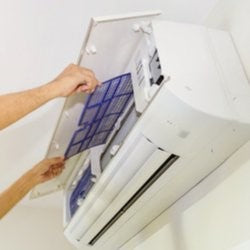
It is important to clean the filters periodically to keep the air conditioner running. Washable filters should be cleaned every 3 to 6 months if you find them covered with a lot of dust and dirt, especially before the winter and summer seasons, so that your air conditioner works with high efficiency.

Thermostat
Room air conditioners are designed using a thermostat sensor, located behind the control panel, which measures the unit's air temperature.
If your air conditioner isn't blowing any cool air, check the temperature setting on the control unit. If it's set to "on," make sure the thermostat is also set to "cool" (refer to the manual for more information). You may sometimes need to lower the temperature setting on your control unit. It's also possible that the sensor is out of position; you should call a technician to have it adjusted.
Melting of circuit breakers and valves
Check if the problem is with the fuses or the circuit breaker, then make sure it is switched on and working properly.
It is common in older homes for circuits to become overloaded if the air conditioner is in the same circuit as other appliances such as refrigerators, microwaves, or irons.

Ice buildup on the air conditioner
This usually happens if the fan blower belt is damaged, causing ice to accumulate inside the unit, which reduces the air conditioner's cooling capacity. To check if this is the problem, turn off the unit and lift the cover to see if there is any ice buildup on or behind the filter.
Settings error
Setting the right temperature is essential. If your air conditioner is blowing uncooled air, make sure the control unit is set to "cooling" mode, which is usually indicated by an ice symbol or "cool".
If it is already in this mode, make sure the temperature is low enough for the unit to know it needs cooling. You can test this by lowering the temperature to 16 degrees Celsius on a hot day to check that the emitted air feels cool, before switching it to the optimal level such as 24 degrees Celsius.

This also applies to heating; if you're using an air conditioner to heat your home in winter but it's blowing cold air, check the control unit settings. As a reminder, the main settings are:
- Ice = Cooling
- Sun = Heating
It is normal for your unit to blow cold air during the heating cycle. This is due to the defrost cycle, which switches to "cooling" mode to allow the outdoor unit to heat up and defrost. However, the controller settings may prevent the fan from shutting off. Some controllers allow you to set the fan motor to run continuously, meaning the fan will operate regardless of the settings, defrost cycle, or temperature.
If you are unable to fix the problem, please consult the manual or a maintenance technician.
Air compressor problem
The controls can control the compressor and fan during overtime, especially if your unit is constantly switching on and off. It is also common for the compressor to stop working due to a fault or break in the condenser. An air conditioner cannot work without a working compressor, so you may need to replace it.
Signs that indicate a problem with the air conditioner that needs repair
noise
In some cases, you may hear noises from the air conditioner, either because of dirty air filters, which make it difficult to process the air in the air conditioner during operation, or because the grille is not properly installed, which causes a whistling sound when the fan is running. You should keep the filters clean and focused on the grille to prevent any gaps in the air.
It is important to choose the right size for your unit when replacing the grille; because small air grilles can weaken the current, causing noises. If the noise turns into a rattle or grinding, it is advisable to turn off the unit immediately, as the cause may be a fault in the fan motor, requiring a technician to be called in for repair.
smoke or steam
It is important to turn off the unit if there is steam coming out with a burning plastic or rubber smell!
It is also common for steam to come out of your outdoor unit when it is set to heating, during the winter, due to the defrost cycle which melts frozen condensation into the air to ensure it does not turn into an icebox that blocks airflow over the heating coil.
Water from the outdoor unit
The chilled air conditioner is designed to remove moisture from the air during heating and cooling cycles. In the heating setting, there is water on the ground near your outdoor unit unless it is drained into the garden or downpipe. In the cooling environment, moisture is drawn from the indoor air and therefore the water is drained from the roof area into the drains.

Reset the unit
If there is a power outage, a temperature error, or no cold air is coming out, you may want to try turning off the power to the valve box. If you turn it back on and the problem persists, note any fault codes displayed on the control unit and provide this information to a professional.
Is it time to change your air conditioner?

If a technician has checked your air conditioner and has not been able to fix the problem, it may be time to buy a replacement.
In general, air conditioning units last about nine to ten years, and air conditioners usually consume a lot of energy, so it is worthwhile to invest in a new model, as new units with energy-saving rates help reduce operating costs and may also provide you with some additional features for your comfort.