
Types of electrical plugs
Electrical plugs and sockets vary from country to country around the world. Therefore, we often find that some imported devices need to have their plugs modified using an adapter or by replacing the plug entirely. First, we need to learn about the types of electrical plugs:
type A and B :
These two types are very similar and are widespread in countries that rely on 100-120 volt electricity, such as America, Canada, and Japan, with a power not exceeding 15 amps. Both are characterized by their very small size.
The difference between them is that the first does not have a grounding terminal, while the other does. The importance of grounding lies in discharging excess electrical charges to the ground.

type C :
It is the most widespread in the Arab world, but the weakest and worst of all the options, especially since we rely on it in all our devices, and this is a big mistake.
The problem with this type is that it is easy to break and gets damaged quickly, and it also operates on a very low amperage. Therefore, some people use it in large devices without knowing the appropriate amperage measurement for them, which leads to them melting and causing an electrical problem that may result in bigger problems, God forbid.

type D :
This type is not much different from the previous type except that it can withstand a higher electrical current (up to 5 amps), in addition to having a grounding mechanism, but this type is almost non-existent and never used.

type F and E :
This type is characterized by its ability to withstand higher electricity (up to 16 amps) and operates on 220-240 volt electricity. It is widespread in Arab countries as a safer alternative to type C.
They both work together, and they also have the property of grounding.
In addition to its prevalence in the Arab world, it is the most common in the world, especially in Europe, and it is very suitable for devices that operate under high loads such as refrigerators, washing machines, or irons.

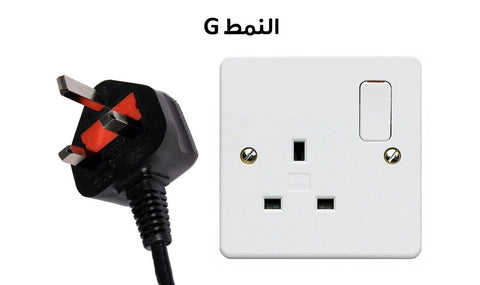
type G :
Despite its large size and high price, it is distinguished by the fact that it can withstand up to (13 amps) of electricity, and it has grounding.
But its biggest advantage is that it has a very high level of safety, and it is difficult to insert metal or plastic pieces to protect children from tampering with electricity.
Another feature is that the plug contains an electrical "fuse" so that any excessive electrical load leads to the fuse burning out and the electrical current being cut off without affecting the device, the plug, or even the electrical outlet.
This type of fish is known as an "English fish" and is very common in Britain and Ireland, but it is also found in the rest of the world, though to a lesser extent.
type H :
Apparently, this type is a modified version of type E, and strangely enough, it is only used in the West Bank and occupied Palestine.
The only difference between them is that the grounding plug is located directly on it.

type L and J and N :
This type C does not differ in the loads it can bear, but it also has the advantage of having an earthing feature, and it is widely used in countries such as Italy, Brazil, Argentina and South Africa.
It is known in our country as an "Italian plug" and can work with type C, but the reverse is not true.
The L pattern is also widespread in Arab countries as a safer alternative to the C pattern.
