
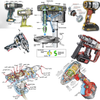
A drill is an indispensable drilling tool in every home and industry.
, by Amer ibrahim, 7 min reading time
, by Amer ibrahim, 7 min reading time
A drill is a vital mechanical tool used to make holes in various materials such as wood, metal, plastic, and even concrete. The drill works by converting electrical or pneumatic energy into rotational motion, allowing the drill bit to cut the material precisely and efficiently.
Whether you're a professional builder or just a DIY enthusiast, understanding how a drill works and choosing the right type for your tasks can make a big difference. In this article, we'll explore the different types of drills and their components.
| Type | Advantages | Disadvantages | Optimal use |
|---|---|---|---|
| electric drill | High power and consistent performance. | It requires a constant power supply. | Jobs that require great strength and continuous performance. |
| cordless drill | Portable, does not require constant electricity. | Limited operating time due to battery. | Household and small businesses in remote areas. |
| pneumatic drill | High thrust and efficient operation under pressure. | It requires a source of compressed air (air compressor). | Industrial use in factories and large workplaces. |
1- Electric drill (corded):

It works by connecting it to a stable 220-volt electrical power source in most Arab countries and 110 volts in most foreign countries.
The drill consists of a motor that generates motion. When the drill is switched on, the power source drives the motor, which in turn rotates the clamp (nut) that holds the drill bit.
The clamp is a vital part of the drill, as it securely holds the drill bit. When the motor rotates, the clamp also rotates, causing the drill bit to rotate. This ensures that the drill bit stays in place and operates efficiently.
The drill bit features a sharp point and grooves (flutes) that cut the material and remove the resulting chips. The drill bit design is based on the type of material being drilled, allowing the drill to operate efficiently in various conditions.
Some types of drills, especially those used in industry, have a feed mechanism that allows the drill bit to advance into the material in a controlled manner. This mechanism helps ensure consistent pressure and depth, contributing to precise results.
When drilling into hard materials, friction can cause a rise in temperature, which can negatively affect the performance of the drill bit. Therefore, coolant is sometimes used to prevent overheating and extend the life of the drill bit.
The drilling process combines rotary motion (from the drill bit) and linear motion (the bit's advance into the material). This coordination of motion allows the drill to create holes accurately and quickly.
2- Cordless drill:
A cordless drill is a power tool that uses a battery as its power source, allowing the user to work in locations far from electrical outlets. It is a popular choice among both professionals and hobbyists due to its versatility and ease of use.
The cordless drill consists of a number of key components that work together to provide efficient performance. Here are the details of each component:

It converts the electrical energy stored in the battery into rotational motion. Its type varies depending on the required power and performance.
They are typically lithium-ion batteries, which offer high power and charging efficiency. The battery can be removable or integrated into the device.
It holds the drill bit, allowing the user to easily change bits. It may be a manual or automatic clamp.
It is available in various sizes and shapes depending on the type of material being worked on (such as wood, metals, plastics).
It allows the user to turn the drill on and off. It may also include speed control features.
It provides ease of control during operation and helps to guide the drill accurately.
It supports all components and is designed to be comfortable and suitable for long-term use.
It helps to cool the motor during operation, thus preventing overheating.
It provides additional lighting while working in dark places.
It displays the remaining charge level in the battery, which helps in planning usage.
3- Pneumatic drill: This is a tool that uses compressed air as a power source to generate rotational motion. It is considered an essential tool in many industries, as it provides high power and efficiency in drilling and rotating.
The pneumatic drill consists of a number of key components that work together to provide efficient performance. Here are the details of each component:
Air motor.
It converts air pressure into rotational motion. The type of motor may vary depending on the application.
Air intake.
It connects to the compressed air source, allowing air to flow to the motor.
The clamp (shaker) : It holds the drill bit, and can be a manual or automatic clamp to facilitate bit changes.
The hole head .
It is available in different sizes and shapes to suit various types of materials.
Power button.
To control the start and stop operation of the drill, and some models have speed control.
Drill frame.
It provides support for all components and is designed to be comfortable and easy to use.
Ventilation system.
It helps cool the motor and prevents overheating.

A drill is an essential tool in every home and workplace, thanks to its ability to facilitate drilling and many other tasks. Whether you choose a corded drill for its high power, a cordless drill for its versatility, or even an air drill for its industrial power, selecting the right tool will ensure you achieve precise and efficient results.
By balancing your personal and professional needs, you can use your drill with maximum efficiency. Always remember that proper maintenance and careful selection will ensure a longer lifespan for your tools.


